

How To Configure a "Full Sharing" User Location Cluster
Description
Section titled “Description”Tip: For a broader view on the “full sharing” topology, see this blog post.
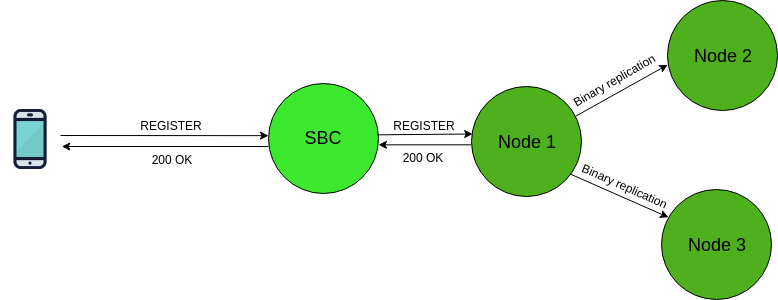
The “full sharing” clustering strategy for OpenSIPS 2.4+ user location implementations is a way of performing full-mesh data replication between the nodes of an OpenSIPS cluster. Each node will hold the entire user location dataset, thus being able to serve lookups for any SIP UA registered to the cluster. This type of clustering offers:
- high availability (any cluster node can properly serve the incoming SIP traffic)
- distributed NAT pinging support (NAT pinging origination can be spread across cluster nodes)
- restart persistency for all cluster nodes
- good horizontal scalability, capped by the maximum amount of data that a single node can handle
Building upon this setup, the federated user location clustering strategy ensures similar features as above, except it will not replicate user location data across different points of presence, allowing you to scale each POP according to the size of its subscriber pool.
Active/passive “full sharing” setup
Section titled “Active/passive “full sharing” setup”Configuration
Section titled “Configuration”For the smallest possible setup (a 2-node active/passive with a virtual IP in front), you will need:
- two OpenSIPS instances
- a working shared/virtual IP between the instances (e.g. using keepalived, vrrpd, etc.)
- a MySQL instance, for provisioning
The relevant opensips.cfg sections:
listen = sip:10.0.0.150 # virtual IP (same on both nodes)listen = bin:10.0.0.177
loadmodule "usrloc.so"modparam("usrloc", "working_mode_preset", "full-sharing-cluster")modparam("usrloc", "location_cluster", 1)
loadmodule "clusterer.so"modparam("clusterer", "my_node_id", 1) # node number #1modparam("clusterer", "db_url", "mysql://opensips:opensipsrw@localhost/opensips")
loadmodule "proto_bin.so"
Provisioning
Section titled “Provisioning”INSERT INTO clusterer(id, cluster_id, node_id, url, state, no_ping_retries, priority, sip_addr, flags, description) VALUES \(NULL, 1, 1, 'bin:10.0.0.177', 1, 3, 50, NULL, 'seed', NULL), \(NULL, 1, 2, 'bin:10.0.0.178', 1, 3, 50, NULL, NULL, NULL);| id | cluster id | node_id | url | state | no_ping_retries | priority | sip_addr | flags | description |
|---|---|---|---|---|---|---|---|---|---|
| 14 | 1 | 1 | bin:10.0.0.177 | 1 | 3 | 50 | NULL | seed | NULL |
| 15 | 1 | 2 | bin:10.0.0.178 | 1 | 3 | 50 | NULL | NULL | NULL |
Native “full sharing” clusterer table
NAT pinging
Section titled “NAT pinging”Some setups require periodic SIP OPTIONS pings originated by the registrar towards some of the contacts in order to keep the NAT bindings alive. Here is an example configuration:
loadmodule "nathelper.so"modparam("nathelper", "natping_interval", 30)modparam("nathelper", "sipping_from", "sip:pinger@localhost")modparam("nathelper", "sipping_bflag", "SIPPING_ENABLE")modparam("nathelper", "remove_on_timeout_bflag", "SIPPING_RTO")modparam("nathelper", "max_pings_lost", 5)We then enable these branch flags for some or all contacts before calling save():
    ...    setbflag("SIPPING_ENABLE");    setbflag("SIPPING_RTO");
    if (!save("location"))        sl_reply_error();    ...
To prevent any “permission denied” error logs on the passive node that’s trying to originate NAT pings, make sure to hook the nh_enable_ping MI command into your active->passive and passive->active transitions of the VIP:
opensips-mi nh_enable_ping 1 # run this on the machine that takes over the VIP (new active) opensips-mi nh_enable_ping 0 # run this on the machine that gives up the VIP (new passive)NoSQL “full sharing” cluster with a SIP front-end
Section titled “NoSQL “full sharing” cluster with a SIP front-end”This is the ultra-scalable version of the OpenSIPS user location, allowing you to support subscriber pool sizes exceeding the order of millions. By letting an external, specialized database cluster manage all the registration data, we are able to decouple the SIP signaling and data storage systems. This, in turn, allows each system to be scaled individually, in an efficient manner.
Configuration
Section titled “Configuration”For the smallest possible setup, you will need:
- a SIP front-end proxy sitting in front of the cluster, with SIP Path support
- two backend OpenSIPS instances, forming the cluster
- a NoSQL DB instance, such as Cassandra or MongoDB, to hold all registrations (you can upgrade it into a cluster later)
- a MySQL instance, for provisioning
On the backend layer (cluster instances), here are the relevant opensips.cfg sections:
listen = sip:10.0.0.177listen = bin:10.0.0.177
loadmodule "usrloc.so"modparam("usrloc", "working_mode_preset", "full-sharing-cachedb-cluster")modparam("usrloc", "location_cluster", 1)
# with Cassandra, make sure to create the keyspace and table beforehand:# CREATE KEYSPACE IF NOT EXISTS opensips WITH replication = {'class': 'SimpleStrategy', 'replication_factor': '1'}  AND durable_writes = true;# USE opensips;# CREATE TABLE opensips.userlocation (#     aor text,#     aorhash int,#     contacts map<text, frozen<map<text, text>>>,#     PRIMARY KEY (aor));loadmodule "cachedb_cassandra.so"modparam("usrloc", "cachedb_url", "cassandra://10.0.0.180:9042/opensips.userlocation")
# with MongoDB, we don't need to create any database or collection...loadmodule "cachedb_mongodb.so"modparam("usrloc", "cachedb_url", "mongodb://10.0.0.180:27017/opensipsDB.userlocation")
loadmodule "clusterer.so"modparam("clusterer", "my_node_id", 1) # node number #1modparam("clusterer", "db_url", "mysql://opensips:opensipsrw@localhost/opensips")
loadmodule "proto_bin.so"
...
route {    ...
    # store the registration into the NoSQL DB    if (!save("location", "path-lazy,path-received")) {        send_reply(500, "Server Internal Error");        exit;    }
    ...}
Provisioning
Section titled “Provisioning”INSERT INTO clusterer(id, cluster_id, node_id, url, state, no_ping_retries, priority, sip_addr, flags, description) VALUES \(NULL, 1, 1, 'bin:10.0.0.177', 1, 3, 50, NULL, 'seed', NULL), \(NULL, 1, 2, 'bin:10.0.0.178', 1, 3, 50, NULL, NULL, NULL);| id | cluster id | node_id | url | state | no_ping_retries | priority | sip_addr | flags | description |
|---|---|---|---|---|---|---|---|---|---|
| 14 | 1 | 1 | bin:10.0.0.177 | 1 | 3 | 50 | NULL | NULL | NULL |
| 15 | 1 | 2 | bin:10.0.0.178 | 1 | 3 | 50 | NULL | NULL | NULL |
NoSQL “full sharing” clusterer table
Shared NAT pinging
Section titled “Shared NAT pinging”loadmodule "nathelper.so"modparam("nathelper", "natping_interval", 30)modparam("nathelper", "sipping_from", "sip:pinger@localhost")modparam("nathelper", "sipping_bflag", "SIPPING_ENABLE")modparam("nathelper", "remove_on_timeout_bflag", "SIPPING_RTO")modparam("nathelper", "max_pings_lost", 5)
# partition pings across cluster nodesmodparam("usrloc", "shared_pinging", 1)We then enable these branch flags for some or all contacts before calling save():
    ...
    setbflag("SIPPING_ENABLE");    setbflag("SIPPING_RTO");
    # store the registration, along with the Path header, into the NoSQL DB    if (!save("location", "path-lazy,path-received")) {        sl_reply_error();        exit;    }
    ...