

Sangoma Voice Transcoding
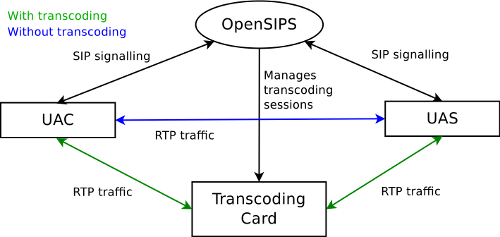
Tutorial Overview
Section titled “Tutorial Overview”This tutorial illustrates the required steps in order to perform audio transcoding with the D-series cards manufactured by Sangoma, using the sngtc_server daemon and the OpenSIPS sngtc module as its client. The latest version of the transcoding library, as of 1 August 2013 is: sng-tc-linux-1.3.4.1
Installing the transcoding card
Section titled “Installing the transcoding card”The necessary firmware for the D-series transcoding cards can be set up using the sngtc_tool. The cards which require PCI connectivity (D100 and D500) also need additional kernel drivers. Please refer to the Sangoma wiki for installation tutorials.
Setting up the sngtc_server
Section titled “Setting up the sngtc_server”Installing the sngtc_server is straightforward and also documented in the Sangoma wiki. After doing the configuration, it can be started using the init script:
$ /etc/init.d/sngtc_server_ctrl startBy default it logs to /var/log/sngtc_server.log
Call flow with the sngtc OpenSIPS module
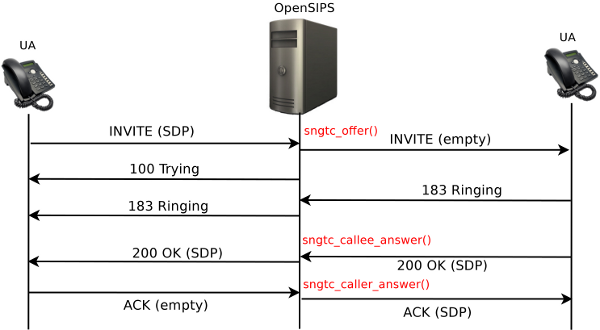
Section titled “Call flow with the sngtc OpenSIPS module”Due to the limitations of the transcoding library, transcoding sessions can only be created if both codec A and codec B are known. Since this cannot be accomplished with a standard SIP call flow, the module restricts the receiving UA to perform late SDP negotiation. The diagram below explains this better:
Using the sngtc module
Section titled “Using the sngtc module”The sngtc module exports 3 functions. They are called upon receiving INVITE, 200 OK and ACK messages. A short overview on their purpose would be:
- sngtc_offer - called at any INVITE request (re-INVITES too), deletes the INVITE SDP body
- sngtc_callee_answer - called at 200 OK responses, intersects codec offers, creates transcoding sessions if necessary
- sngtc_caller_answer - called at ACK requests, adds an SDP body to the ACK request
All functions properly handle retransmissions. More details can be found in the module documentation. A basic configuration file is shown below:
####### Global Parameters #########
log_level=3xlog_level=3stderror_enabled=yessyslog_enabled=nosyslog_facility=LOG_LOCAL0
udp_workers=4
socket=udp:127.0.0.1:5060
####### Modules ########
mpath = "modules/"
loadmodule "exec.so"loadmodule "signaling.so"loadmodule "sl.so"loadmodule "maxfwd.so"loadmodule "sipmsgops.so"loadmodule "db_mysql.so"loadmodule "registrar.so"loadmodule "sngtc.so"
loadmodule "tm.so"modparam("tm", "fr_timeout", 5)modparam("tm", "fr_inv_timeout", 30)modparam("tm", "restart_fr_on_each_reply", 0)modparam("tm", "disable_6xx_block", 1)modparam("tm", "onreply_avp_mode", 1)
#### Record Route Moduleloadmodule "rr.so"/* do not append from tag to the RR (no need for this script) */modparam("rr", "append_fromtag", 0)
#### FIFO Management Interfaceloadmodule "mi_fifo.so"modparam("mi_fifo", "fifo_name", "/var/tmp/opensips_fifo")modparam("mi_fifo", "fifo_mode", 0666)
#### DIALOG moduleloadmodule "dialog.so"modparam("dialog", "db_mode", 0)modparam("dialog", "default_timeout", 3600)
#### USeR LOCation moduleloadmodule "usrloc.so"modparam("usrloc", "working_mode_preset", "single-instance-no-db")modparam("usrloc", "db_url",  "mysql://opensips:opensipsrw@localhost/opensips")
loadmodule "proto_udp.so"
####### Routing Logic ########
route {
  if (!mf_process_maxfwd_header(10)) {    sl_send_reply(483, "Too Many Hops");    exit;  }
  force_rport();
  if (has_totag()) {    # sequential request withing a dialog should    # take the path determined by record-routing
    if (loose_route()) {
      if (is_method("BYE")) {        setsflag(FAIL_TRANS_FLAG);      } else if (is_method("INVITE")) {        sngtc_offer();      } else if (is_method("ACK")) {        sngtc_caller_answer();      }
      # route it out to whatever destination was set by loose_route()      # in $du (destination URI).      route(relay);    } else {
      if (is_method("ACK")) {        if (t_check_trans()) {          # non loose-route, but stateful ACK; must be an ACK after          # a 487 or e.g. 404 from upstream server          t_relay();          exit;        } else {          # ACK without matching transaction ->          # ignore and discard          exit;        }      }      sl_send_reply(404, "Not here");    }    exit;  }
  # CANCEL processing  if (is_method("CANCEL")) {    if (t_check_trans())      t_relay();    exit;  }
  # absorb retransmissions, but do not create transaction  t_check_trans();
  # preloaded route checking  if (loose_route()) {    xlog("L_ERR",      "Attempt to route with preloaded Route's [$fu/$tu/$ru/$ci]");    if (!is_method("ACK"))      send_reply(403, "Preload Route denied");    exit;  }
  # record routing  if (!is_method("REGISTER|MESSAGE"))    record_route();
  # requests for my domain  if (is_method("PUBLISH|SUBSCRIBE")) {    send_reply(503, "Service Unavailable");    exit;  }
  if (is_method("REGISTER")) {    if (!save("location"))      sl_reply_error();
    exit;  }
  if (!$rU) {    # request with no Username in RURI    send_reply(484, "Address Incomplete");    exit;  }
  # do lookup with method filtering  if (!lookup("location","method-filtering")) {    t_reply(404, "Not Found");    exit;  }
  if (is_method("INVITE"))    sngtc_offer();
  route(relay);}
route[relay] {  # for INVITEs enable some additional helper routes  if (is_method("INVITE")) {    t_on_reply("handle_answer");    t_on_failure("missed_call");  }
  if (!t_relay()) {    send_reply(500, "Internal Error");  }
  exit;}
onreply_route[handle_answer] {  if ($rs == 200)    sngtc_callee_answer("11.12.13.14", "11.12.13.14");}
failure_route[missed_call] {  if (t_was_cancelled()) {    exit;  }
  if (next_branches()) {    t_on_reply("handle_answer");    t_on_failure("missed_call");    t_relay();  }}
The transcoding sessions on the Sangoma cards are closed in a transparent manner, based on dialog callbacks.